When to visit?
It is a matter of choice whether you would like to plan your Serengeti safari around the Great Migration. We have mentioned earlier that the Serengeti is a
year-round destination as it covers a vast area and offers unparalleled wildlife
viewing. Chances that you will be at the exact spot of the Great Migration herd
crossing a river (either at the Grumeti or Mara River) are very slim. Also, the
timing of herd movements cannot be guaranteed. However, if you choose the
right part of the Serengeti: the southeast and Ndutu from December through to
May, the Western Corridor from May to July, the Serengeti Mara area from July
trough to October, and the northern Serengeti and Lobo area in October and
November, large herds of wildebeest and their entourage should be easily located.
A better representation of the circle of life probably cannot be found anywhere
else in the world. The journey starts in Southern Serengeti when wildebeest
calves are being born. Predators like lions and hyenas are constantly hunting for
babies, and thousands and thousands of calves are born within a couple weeks of
each other – a feast for the eyes of true wildlife enthusiasts.
When the drought comes in May, the herd moves north, towards the Masai Mara
in Kenya, chomping down the high green grass, quickly followed by the gazelles
and zebras. The migration is not without risk: crossing rivers means facing about
3,000 crocodiles, patiently waiting for a kill. Not to mention the famous Serengeti
lion population: by far the largest in Africa. Despite the abundance of hoofed
meat in this area, life is not easy for these big cats in this unforgiving landscape.
But seeing a group of lions collaborating to hunt down a wildebeest is an
unforgettable sight.
Then, with the beginning of the short rains in late October, the migration makes
its way back into the Serengeti. By December, the herds trek past Seronera - a
small settlement in central Serengeti where the official Serengeti Visitors’ Centre
is located - to return to their calving grounds again, and the circle is complete.
The Great Migration in detail
When planning your Serengeti safari you probably want to include seeing the
Great Migration. So how do you ensure to be there when it happens? The long
and short of it is that you can’t. It is important to realize that the decision of when
to visit the Serengeti always involves an element of risk. We have detailed the
Great Migration below, and this is what usually happens, but keep in mind that
there are no guarantees.
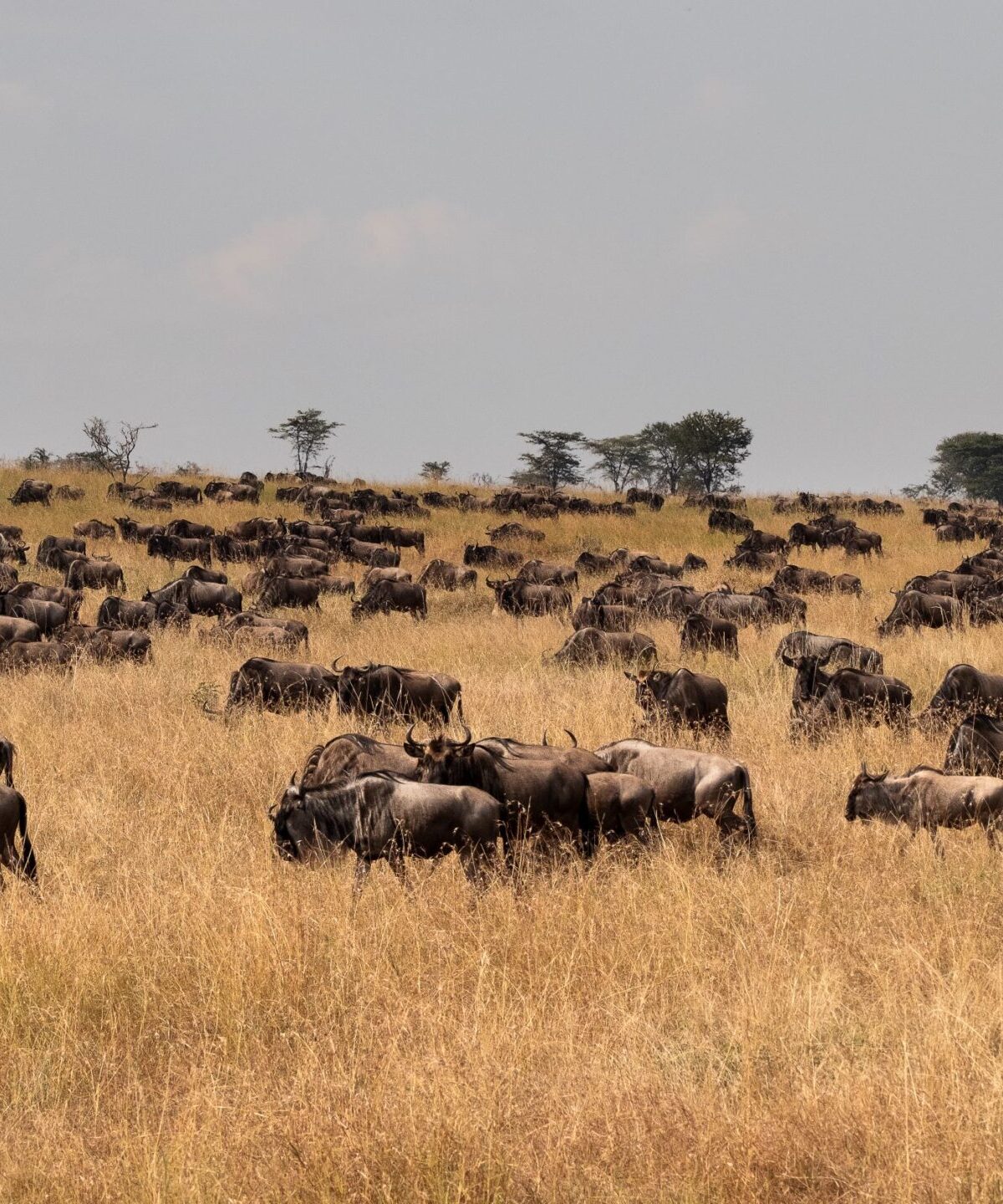
The annual migration of two million ungulates, wildebeest but also enormous
groups of zebra and Thomson's gazelle, Grant's gazelle and eland, through
Serengeti National Park is the greatest wildlife spectacle of its type in Africa, and
perhaps the world. Although variations occur from year to year, the Serengeti
migration follows a reasonably predictable annual cycle, dictated by local rainfall
patterns. The Great Migration cycle breaks up into the following periods:
December-April
We can find the main calving grounds in the area southeast of Seronera: typical
Serengeti plains stretch all the way to the Ndutu area near Ngorongoro.
Triggering their move to this area are the short rains in November and December.
The wildebeest stick around this area until the end of the long rains, end of April,
early May. The delightful news is that this section of Serengeti National Park is
easily accessible and that in this period the landscape becomes lush. February is
usually calving season in the Ndutu area and the southeastern plains: the very
best time to visit this area. As wildebeest, zebra and other ungulates are so many,
and give birth to so many calves, the spectacle works as a magnet for predators.
As early as March or April the herd may move again in search of greener pastures.
Seeing the actual migration in this period is more difficult, but chances are that
you will encounter very large herds on the move.
May-July
This is the period that the wildebeest, after having feasted on the short green
grasses of the southeastern Serengeti and after having giving birth to their
offspring, start getting ready for their 800 kilometer long trek. The actual starting
date may be anytime between late April and early June. This is the time to you
may have the privilege to see one of the greatest natural phenomena in the world:
more than a million marching animals in a column up to 40 kilometers long.
During the migration, the herd will move towards the Western Corridor, where
they will face the first major obstacle: crossing the Grumeti River. Many animals
don’t survive the crossing as they are being awaited by the area’s population of
oversized crocodiles ready to feast. The herd may congregate on the southern
bank of the river and stay there for up to two weeks before crossing the river.
August-September
When the Grumeti River obstacle has been taken, the herd moves further north
and starts crossing the next big hurdle, the Mara River, in July or August. The
Mara River crossing is where so many iconic Great Migration photos have been
taken. After this crossing the herd flocks to the northwest plains and Masai Mara
National Reserve in Kenya. The August – September period is considered being a
bad time to visit Serengeti National Park and see the Great Migration as the herd
moves into the Masai Mara in Kenya. However, migration patterns show that
about half of the herd stays on the Tanzanian side, in the Mara Serengeti area. In
this period, smaller herds of wildebeest (well consider small… herds may count
up to between 500 and thousands of individuals) frequently cross the Mara River,
back and forth, for no apparent reason. This is an excellent time to stay at one of
the Serengeti Mara camps.
October-November
Crossing the Mara River northbound means that, at one point, the herd needs to
cross the river one more time before commencing the trek back in a southerly
direction. This usually happens in October, but sometimes earlier. In this period
the herd will cross the northern plains and Lobo area. This section of Serengeti
National Park is little-visited, so if you are looking to see the migration in relative
quietness, this would be the time. The wildebeest return to the short- grass
plains and calving ground around Ndutu in late November. And from here, the
Great Migration starts all over again.